









The jew will pay the price.
Each time a man stands up for Truth, he sends forth a ripple of hope and justice.
Regards,
AoM



Each time a man stands up for Truth, he sends forth a ripple of hope and justice.
Regards,
AoM





The cure
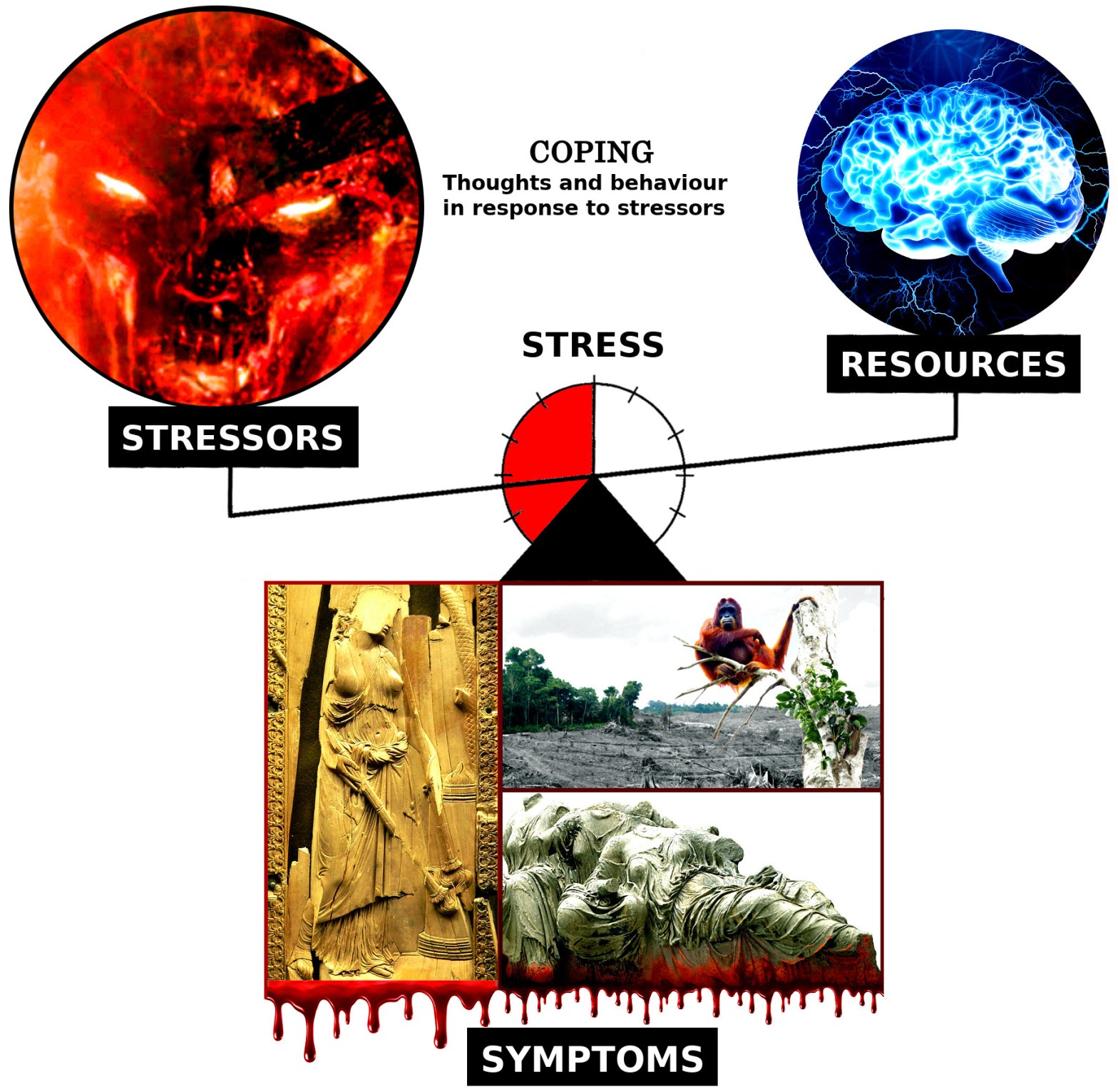
A simplified version of the predominant model of stress and coping in psychology
I approach this subject as a clinical psychologist (four degrees, including PhD) with a specialist interest in stress and coping and 40 years’ work as a fully qualified clinical psychologist. I do this by conceptualizing the information within a model of stress and coping as follows.
The predominant model of stress and coping in psychology acknowledges four categories:
Coping resources are also referred to as moderator variables (they moderate the relationship between stressors and outcomes), vulnerability factors or resilience factors.
Naturally these four categories are interrelated, e.g. illness can be an outcome, stressor, and it can mean reduced coping resources. Same for the loss of a supportive interpersonal relationship and many other factors that can occur in several categories.
Effective coping reduces stress by principles articulated in the Serenity Prayer, including this Mother Goose rhyme version:
For every ailment under the sun
There is a remedy, or there is none;
If there be one, try to find it;
If there be none, never mind it.
For situations that are changeable effective coping involves efforts to change the situation (problem-focused coping), e.g. financial stress can be reduced by leading a simpler lifestyle, work stress can be reduced by changing jobs, societal stress can be reduced by serving justice on the gangsters controlling our societal levers, ecological collapse can be mitigated by nature conservation efforts.
For situations that are not changeable (e.g. permanent disability, loss of a loved one, terminal illness) effective coping involves efforts to reduce the severity of stress (emotion-focused coping), e.g. catharsis (releasing emotions through talk, crying, laughter, music, writing, art), spiritual activities (meditation, being in nature), social support (being with friends who understand, accept and love us). Concerning social support, even just one close confiding relationship can substantially improve coping during times of stress.
Changeable or not changeable?
The first step in effective coping is accurate assessment of the situation and the extent to which it is changeable. Processes that are beyond human control include those of the solar system, the cycle of ages in Hindu cosmology, glacial / inter-glacial periods including our current descent into a glacial period (Climate change), geological ages, and the spiritual principle of cause and effect (aka Karma, Örlög, Wyrd, God’s immune system) to which we are all subject. For example, God is reacting to humans’ destruction of His creations (the ecological catastrophe known as the Holocene extinction, a subject also discussed in the post Revenge in realms of Death).
In contrast, among the many ways in which we can influence our future to some extent are our choice of religion (e.g. anti-life Abrahamic religion vs pro-life natural religion), lifestyle (e.g. destructive consumerism vs Nature/God-conscious living) and politics (e.g. submitting to our attackers vs removing them from power by means that include support for leaders who stand for truth, life, and justice).
Our dire societal situation is changeable, it is changing, and it’s changing fast.
The positive change
Consistent with information online, I’ve seen a dramatic awakening to jew psychopathy (evil) among my relatives, friends and acquaintances within the peak of Solar Cycle 25. This includes widespread knowledge of jews’ pan-vaxx attack (fake CV-19 “pandemic” + deadly “vaxx”), Climate-Con, Christ-Con, contrived ‘wars’, theft by central banking and other means, Holohoax, the psychopathic nature of Judaism as stated in their holiest book (Talmud) and by rabbis, and reasons for jews being kicked out of civilized societies on at least 1,030 occasions across the history of this psychopathic Tribe.
Associated with this awakening to Abrahamic evil, online and in ‘real’ life I’ve seen evidence of a spiritual awakening, including rejection of Christ-insanity and increased interest in natural religion, meditation, and the Golden Age (Satya Yuga). Corroborating my impressions more generally is the surge of clicks on my blog posts concerning these subjects. We are moving from the Dark Age (Kali Yuga) into the Golden Age. Perceptive people know this and are preparing for it. Preparations include those which might favour survival of the societal collapse (mediated by a number of factors, including Abrahamic mind-rot) predisposed by global cooling toward another glacial period (Climate change and The reality of climate).
Where do ET Aliens fit into this?
We can see a process whereby the destructive power of jews and their collaborators is being neutralized through widespread exposure of their lies and deception, i.e. their coping resources (the power of their various scams from biblical lies to pan-vaxx) are evaporating in the light of truth.
This mass awakening includes the truth of who we are — our creators, educators, culture, history, and membership of a universal family.
Psychological abuse involves dis-empowering intended victims in ways that include (a) undermining their self-esteem (e.g. “You are descended from monkeys”), (b) isolating them from potential sources of help (e.g. “There is no advanced intelligent life elsewhere in the universe”), and (c) intimidation (e.g. “Take this ‘vaccine’ or you will die”). Recovery from psychological abuse involves recovery of our power, including that of knowledge.
Jews and their collaborators have abused and exploited us in all manner of ways that would not have been possible if we had known the truth, including the truth about ET Aliens.
Fortunately, the subject of ET Aliens is no longer the domain of crazies and con-artists. It is now a field studied by respected scientists, engineers and other professionals. As will be shown in the forthcoming 12 posts on the reality of our gods, there is now a vast body of evidence and research publications concerning the reality of ET Aliens. This knowledge is helping to set us free.
In many ways, effective coping involves living in the truth of The Nine Noble Virtues. Following are extracts from The Nine Noble Virtues, formulated from texts of ancient European paganism. This is powerful stuff, especially when we consider that European paganism can be traced to Anunnaki teachings in ancient Sumer that are also represented in the universal symbolism of the D&M Pyramid on Mars. People such as Adolf Hitler (privately he was essentially pagan and intensely opposed to Judaism and Christianity) who represent our highest ideals, live in the truth of The Nine Noble Virtues.
Truth
From the Hávamál:
I counsel you second; swear no oath
But what you mean to abide by.
A halter awaits the word breaker,
Villainous is the wolf-of-vows.
Courage
From the Hávamál:
The coward believes he will live forever
if he holds back in the battle.
But in old age he shall have no peace
though spears have spared his limbs.
Honour
From the Eddic poem Sayings of the High One:
Cattle die, kinsmen die
one day you yourself shall die
but the reputation of the dead never dies.
Fidelity
From the Hávamál:
If you find a friend you fully trust
And wish for his good-will,
exchange thoughts,
exchange gifts,
Go often to his house.
Self-discipline
From the Hávamál:
Early shall he rise who rules few servants,
And set to work at once.
Much is lost by the late sleeper,
Wealth is won by the swift.
Hospitality
From the Hávamál:
Fire is needed by the newcomer
Whose knees are frozen numb.
Meat and clean linen a man needs
Who has fared across the fells.
Industriousness
From the Hávamál:
Cattle die, kindred die,
Every man is mortal:
But the good name never dies
Of one who has done well.
Self-reliance
From the Hávamál:
One’s home is best, though small it be
To each home is hall.
The heart bleeds in the beggar who must
Ask at each meal for meat.
Perseverance
From the Hávamál:
May the halt [one who is lame] ride a horse
and the handless be herdsman,
the deaf man may doughtily fight,
a blind man is better than a burn one [on fire] ay;
of what gain is a good man dead?
Dedication
The following 12 posts are dedicated to men and women of noble virtues.
Toward the Light
Post outline
The Bible was once believed to be the oldest book in the world, with completely original stories. That was before excavations in Mesopotamia in the mid-19th century revealed that Hebrew scribes stole biblical stories from pagan sources. Translated cuneiform showed that many biblical stories originated in Mesopotamia (World History). Examples of the Hebrews’ self-serving theft are presented below.
The Epic of Gilgamesh, some of which dates back to 2100 BCE Mesopotamia, is a foundational work in religion.
Epic of Gilgamesh and Hebrew Bible similarities
There are striking similarities between the Epic of Gilgamesh and the Hebrew Bible (similar to the Christian Old Testament), which dates back to the 8th/7th centuries BCE. Wikipedia notes that accounts of the following subjects in the Epic and Bible are correlated:
In both stories a human is created from the soil by a god and lives in nature; he is introduced to a female congener who tempts him; the man accepts food from the woman; he covers his nakedness; he must leave his former home, unable to return; a snake steals a plant of immortality from the hero.
“A triple-stranded rope is not easily broken.” This rare proverb about the strength of a triple-stranded rope is in both books.
The Genesis flood story follows the Gilgamesh flood tale point by point and in the same order. This close match indicates that the Genesis flood story originates in a Mesopotamian account. In the Epic, the man who is told to build a boat before the great flood is called Utnapishtim. In Genesis he is named Noah.
In the Epic, the Sumerian goddess of life, Ninti, was created from Enki’s rib. It seems that this story served as the basis for the tale in Genesis about Eve being created from Adam’s rib.
The Epic of Atrahasis dates back to at least c. 1650 BCE.
Creation of humans
The Epic explains the creation of humans by the Anunnaki gods Anu, Enlil, and Enki (rulers of the sky, Earth, and freshwater sea respectively) for the purpose of doing manual work such as farm labor and maintenance of rivers and canals. The work was undertaken by mother goddess Mami. She created humans by shaping clay, spat upon by all the gods, into figurines mixed with the flesh and blood of the slain god Geshtu-E. After 10 months humans were born from a specially made womb.
The flood
The Epic contains the flood story: Enki (a) warns the hero Atrahasis of Enlil’s plan to destroy mankind by flood, (b) tells him to build a boat to escape, (c) says that the boat should (i) have a roof “like Abzu” (a subterranean, freshwater realm presided over by Enki), (ii) have upper and lower decks, and (iii) be sealed with bitumen.
Atrahasis boards the boat with his family and animals, seals the door, and the storm and flood begin. The flood ends after seven days and Atrahasis offers sacrifices to the gods.
Enuma Elish (also known as The Seven Tablets of Creation) is a Babylonian creation myth dated to the 9th century BCE. It is a story of the great god Marduk’s victory over the forces of chaos and his establishment of order at the creation of the world.
There are many similarities between Enuma Elish and the Atrahasis epic. Enuma Elish describes the creation of the world and the creation of man destined for the service of the Mesopotamian deities.
According to this account, before creation, when only the primordial entities Apsu and Tiamat existed and co-mingled, there were no other things or gods. Then from the mixture of Apsu and Tiamat two gods issued: Lahmu and Lahamu. Then Anshar and Kishar were created. From Anshar came the god Anu, and from Anu, came the god Nudimmud (also known as Ea). Within the Apsu, Ea and Damkina created Marduk.
Marduk told Ea that he would use his own blood to create man, and that man would serve the gods. Ea advised one of the gods be chosen as a sacrifice; the Igigi advised that Kingu be chosen. His blood was then used to create man.
As is the case with the Epic of Gilgamesh and the Epic of Atrahasis, Enuma Elish contains numerous parallels with passages of the Hebrew Bible. In particular, both Enuma Elish and the Bible refer to:
Joshua J. Mark (2018) notes major points in the Enuma Elish:
As will be discussed in a later article, these themes also occur in European paganism (Odinism / Wotanism).
Points from Stanley Wilkin (2019), University of London, Jesus and Bel Christianity and the Continuation of Paganism:
Although Jesus was supposedly born on 25 December, his birthday was not declared as such until the fifth century. That day was previously named a holiday in honour of the Roman sun god Sol Invictus (Sanders, E. P., 1993, The Historical Figure of Jesus, London, England, New York City, New York).
The Gospel of Mark
This Gospel is a jew retelling of the Odyssey, with Jesus as its central character instead of Odysseus (MacDonald, Dennis R., 2013, Mythologizing Jesus: From Jewish Teacher to Epic Hero, Lanham, Maryland: Rowman & Littlefield).
The Gospel of John
This Gospel contains ideas from Platonism and Greek philosophy: The “Logos” in John’s prologue was devised by philosopher Heraclitus and adapted to Judaism by Philo Judaeus (Philo the Jew) of Alexandria (Porter, Stanley E., 2015, John, His Gospel, and Jesus: In Pursuit of the Johannine Voice, Grand Rapids, Michigan: Wm. B. Eerdmans Publishing Company, pp. 102–104).
The Gospel of John also seems to have been influenced by symbolism associated with the cult of Dionysus, the Greek god of wine, e.g. Jesus’ miracle of turning water into wine at the Marriage at Cana in John 2:1–11 resembles stories that were told about Dionysus (Salier, Willis Hedley, 2004, The Rhetorical Impact of the Sēmeia in the Gospel of John, Tübingen, Germany: Mohr Siebeck) and Jesus’ declaration of himself as the “True Vine” sounds like Dionysus, who discovered the first grape vine (Shorrock, Robert, 2011, The Myth of Paganism: Nonnus, Dionysus and the World of Late Antiquity, A&C Black).
The Gospel of John also contains parallels with The Bacchae, a tragedy featuring Dionysus as a central character. It was written by Athenian playwright Euripides and first performed in 405 BCE.
As in the Gospel of John, the central figure is an incarnate deity who arrives in a country where he should be known and worshiped. However, because he is disguised as a mortal, the deity is not recognized and is instead persecuted by the ruling party (Stibbe, Mark W. G., 1993, The Elusive Christ: A New Reading of the Fourth Gospel, The Gospel of John As Literature: An Anthology of Twentieth-Century Perspectives, Leiden, The Netherlands: Brill).
Like Dionysus in Euripides’ Bacchae, in the Gospel of John, Jesus is elusive, makes ambiguous statements to evade capture, is supported by a group of female followers, and one of the central figures suffers a violent death (Stibbe, Mark W. G., 1994, John as Storyteller: Narrative Criticism and the Fourth Gospel, Cambridge, England: Cambridge University Press).
Water of life
In the New Testament, Jesus is called the “water of life.” Similarly, a votive altar to Mithras from Poetovio calls him the fons perennis (“the ever-flowing stream”) (Clauss, Manfred, 2001, The Roman Cult of Mithras: The God and His Mysteries, translated by Gordon, Richard, New York City, New York and London, England: Routledge).
Healing miracles
The supposed healing miracles of Jesus are similar to the miracles associated with Asclepius, the Greek god of healing and medicine (Edelstein, Emma J.; Edelstein, Ludwig, 1998, Asclepius: Collection and Interpretation of the Testimonies, Baltimore, Maryland: The Johns Hopkins University Press).
From the article Dying-and-Rising Gods (2018) by Richard Carrier, Ph.D. in ancient history, specialist in the modern philosophy of naturalism and humanism, and the origins of Christianity:
Many cultures around the borders of Judea had a dying and rising personal savior god. The idea was fashionable. It is unsurprising that some fringe jews decided to invent their own dying and rising savior, this time a jew. If any erudite religious scholar in 1 BCE had been asked what a future Jesus cult would look like, he would have described the entire Christian cult precisely, before it even existed.
Richard Carrier (2018) on the following dying and rising savior gods:
Osiris
Like Jesus, he died during a full moon and was resurrected on the “third day.” Like Jesus, after being restored to life in his deceased body, Osiris visits people on earth and then rules from heaven above.
Dionysus
In a popular tale about Dionysus (also known as Bacchus), after being killed as a baby, he is resurrected by a human woman (Semele). Dionysus is a “reborn” savior god. Like Christians (1 Corinthians 15:29), those baptized into his cult received eternal life in paradise.
Zalmoxis
Zalmoxis is another resurrected savior. He died and rose from the dead. Zalmoxis appeared in his same body and visited his followers to prove he was alive.
Inanna
Clay tablets inscribed in Sumer over a thousand years before Christianity describe Inanna’s humiliation, trial, execution, crucifixion, and her resurrection three days later. Inanna was “turned into a corpse,” “the corpse was hung from a nail,” and “after three days and three nights” her assistants ask for her corpse and resurrect her (by feeding her the “water” and “food” of life). Her cult continued to be practiced into the Christian period.
Adonis
Adonis, who is sometimes equated with Tammuz, is another resurrected savior. There were national ceremonies of mourning for Adonis’ death followed the next day by celebrations of his return to life and ascending into outer space. It is likely that the resurrection of Adonis was celebrated long before Christianity began.
Romulus
Romulus is another resurrected savior god before Christianity. He is murdered, his corpse vanishes, the sun goes out, people flee in fear and mourn his death; then he returns to earth alive, resurrected in a new divine body. Then he preaches his gospel to the disciple Proculus before departing to rule from heaven.
Asclepius
By a god (Zeus) Asclepius was turned into a bloodless corpse. Then Zeus restored Asclepius to life. After this resurrection, Asclepius was immortal, eternal, and supernaturally powerful, like Jesus.
Baal
The death of Baal (or “Ba’al”) is likely the same death mourned under the name Hadad-Rimmon in Zechariah 12:11. Baal’s corpse is found by Anat and multiple gods declare him dead. After Baal is then buried and funeral rites performed, he is resurrected and lives forever. Later, but before the onset of Christianity, Baal becomes a personal savior god.
Hercules
The legend of Melqart became fused with that of Hercules. After Hercules was killed by Typhon, Iolaus restored him to life by ritually burning a quail. After he was raised from the dead, Hercules ascended to heaven with divine power, like Jesus.
The idea of resurrection, especially of the whole world at a designated end-time, was pagan.
Richard Carrier concludes:
Please see the post The Christ-Con and its Cure
Please see the post The psychopathic Tribe’s cruel hoax: Christianity
Please see these posts:
Odinism and recovery from the Christian catastrophe
Christianity kills
Revenge in realms of Death
Following orders
To do evil is Judaism (Psychopathic religious instruction). To do great evil the jew needed Christians. Considering their (a) delusions, numbers, and collective power; and (b) their reckless destruction of others’ cultures, lives, and the ecosystems upon which all our lives depend; (c) has there ever been a greater human threat to life on Earth than the Christian? By their own admission (Satan: King of the jews) and deeds (Psychopathic conduct), jews serve Lucifer. By their insane religious convictions, service to the jew, and global devastation, Christianity too is a most dangerous Satanic cult.



 Aspects of Mind