Post outline
- Introduction
- Context
2.1 Climate
2.2 Religion
2.3 Yin and yang - Concepts in the OLB
3.1 Sky god and Earth mother
3.2 Ethnocentrism
3.3 Respectful treatment of other groups
3.4 Freedom
3.5 Contempt for arrogance
3.6 Language
3.7 Other - The destruction of Atlantis
- Jessos
- References
- Appendices
1. Introduction
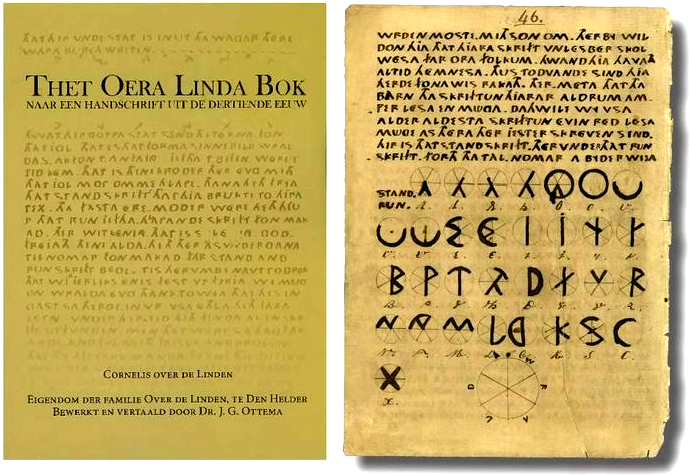
The Oera Linda Book (OLB)1 resonates with the Aryan psyche like no other. This ancient text offers a blueprint for our spiritual, religious, and political recovery. The OLB is extremely dangerous to the liars, thieves, and murderers presently in control of our societal levers. For example, they have attacked the authenticity of the OLB in Wikipedia (‘jewpedia’).2
It is easy to see why Heinrich Himmler (a German National Socialist politician) was greatly impressed by the OLB and consequently, together with Herman Wirth and Richard Walther Darré, on 4 May 1934, he founded Ahnenerbe (Ancestral Heritage), an organization comprising academics and scientists from a broad range of academic disciplines to investigate the prehistoric roots of the Aryan race.3 More recently, in 1999, Russian political philosopher Alexander Dugin highlighted what any perceptive reader of the OLB can see: the book can easily be transformed into political ideologies that resonate with all Aryans.4
Dr J. G. Ottema (1871, in the introduction to the OLB)1 states the following about the OLB:
- It is a very ancient manuscript written by generations of a Fryan (named after their deity Frya) family over a period of five centuries as of 1256 BCE. It records a succession of dates and events starting from the destruction of Atland [âldland, old land, in Latin Atlantis] in 2193 BCE. Since time immemorial, the manuscript was preserved in the family of C. over de Linden, Chief Superintendent of the Royal Dockyard at the Helder.
- The writing bears no mythical character and it has no traces of acquaintance with the Northern or Scandinavian Mythology.
- It records ideas of religion that are entirely different from the mythology of other nations and in some points is closest to Greek and Roman Mythology.
- The whole contents of the book are entirely new — there is nothing in it with which we were previously acquainted.
- The Frisian religion is extremely simple and pure Monotheism: (a) Wr-alda [God] is the only eternal, unchangeable, perfect, and almighty being, (b) He created everything, and (c) out of Wr-alda proceeds everything—first the beginning, then time, and afterwards Irtha, the Earth.
Authenticity
In his presentation at a meeting of the Frisian Society, February 1871, Dr J. G. Ottema said that Dr E. Verwijs had examined the manuscript and immediately recognised it as very ancient Fries, and that Dr J. G. Ottema too was convinced of the document’s great age.1 Evidence cited by Dr Ottema to substantiate his conclusion includes:
- Origin of the writing. The language used in the first part of the book is very old Fries, even older and purer than the Fries Rjuchtboek or old Fries laws. The locality of this spoken language must have been between the Vlie and the Scheldt.
- Changes in the writing. Peculiarities of the successive writers show changes in pronunciation that occurred over the five centuries of their writing.
- Paper and ink. The large size, cotton material, origin of such paper, and type of ink, unequivocally indicate that the manuscript could not have been started later than 1256 BCE.
- Revealed knowledge. Information in the latter part of the book indicates that the writer was a contemporary of Julius Caesar.
- Consistency. The accounts never contradict each other and are always consistent with each other in time and place.
2. Context
2.1 Climate
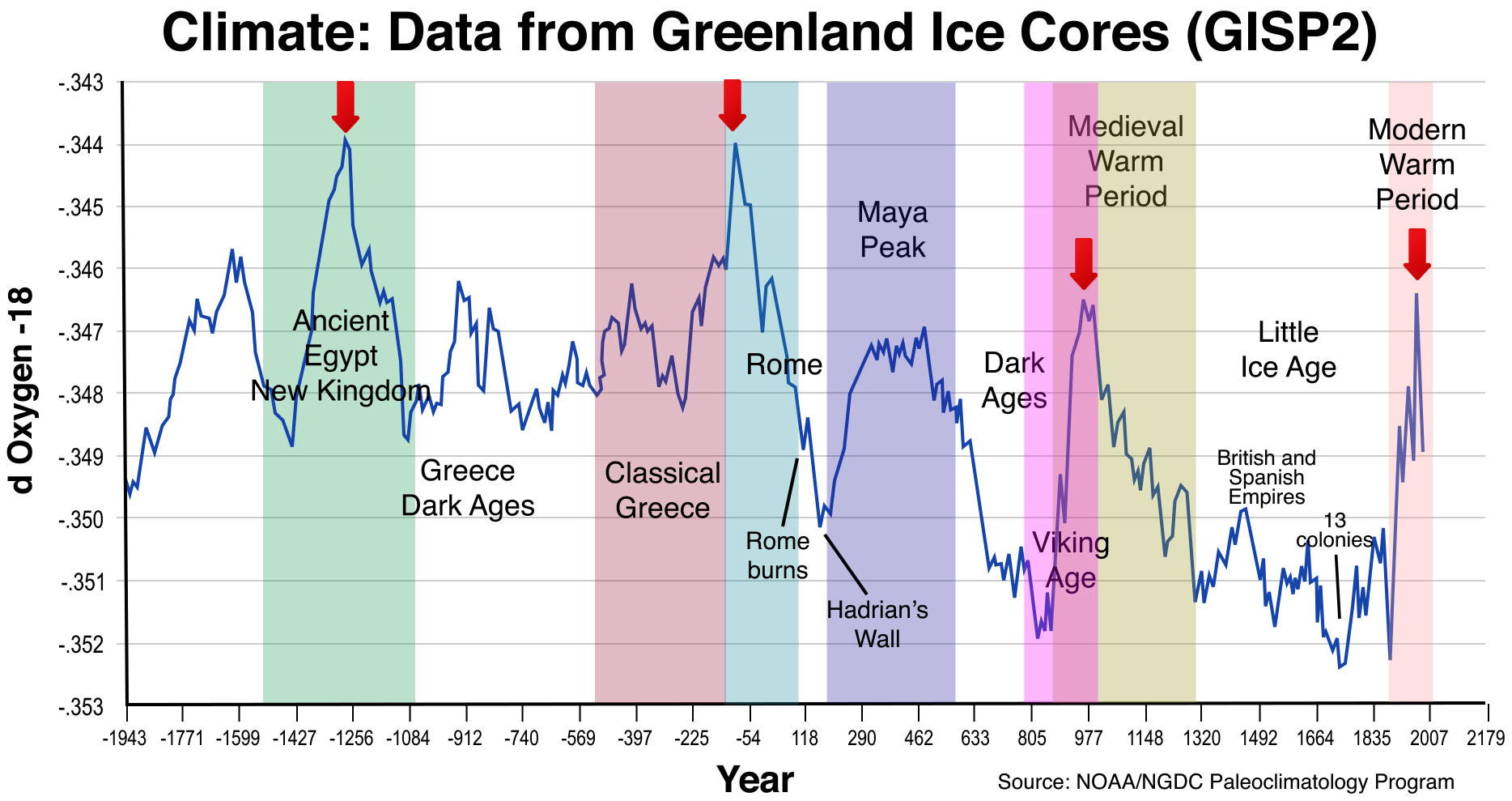
Civilizations as of the New Kingdom of Ancient Egypt
Climate and resource availability are major factors in the rise / fall of civilizations.5 For further evidence of the positive association of nations’ rise / fall with climate, consider the start / end dates of empires as listed on Wikipedia6 in relation to this chart.
The positive association of nations’ rise / fall with climate can also be seen on the larger time-scale of the following chart.
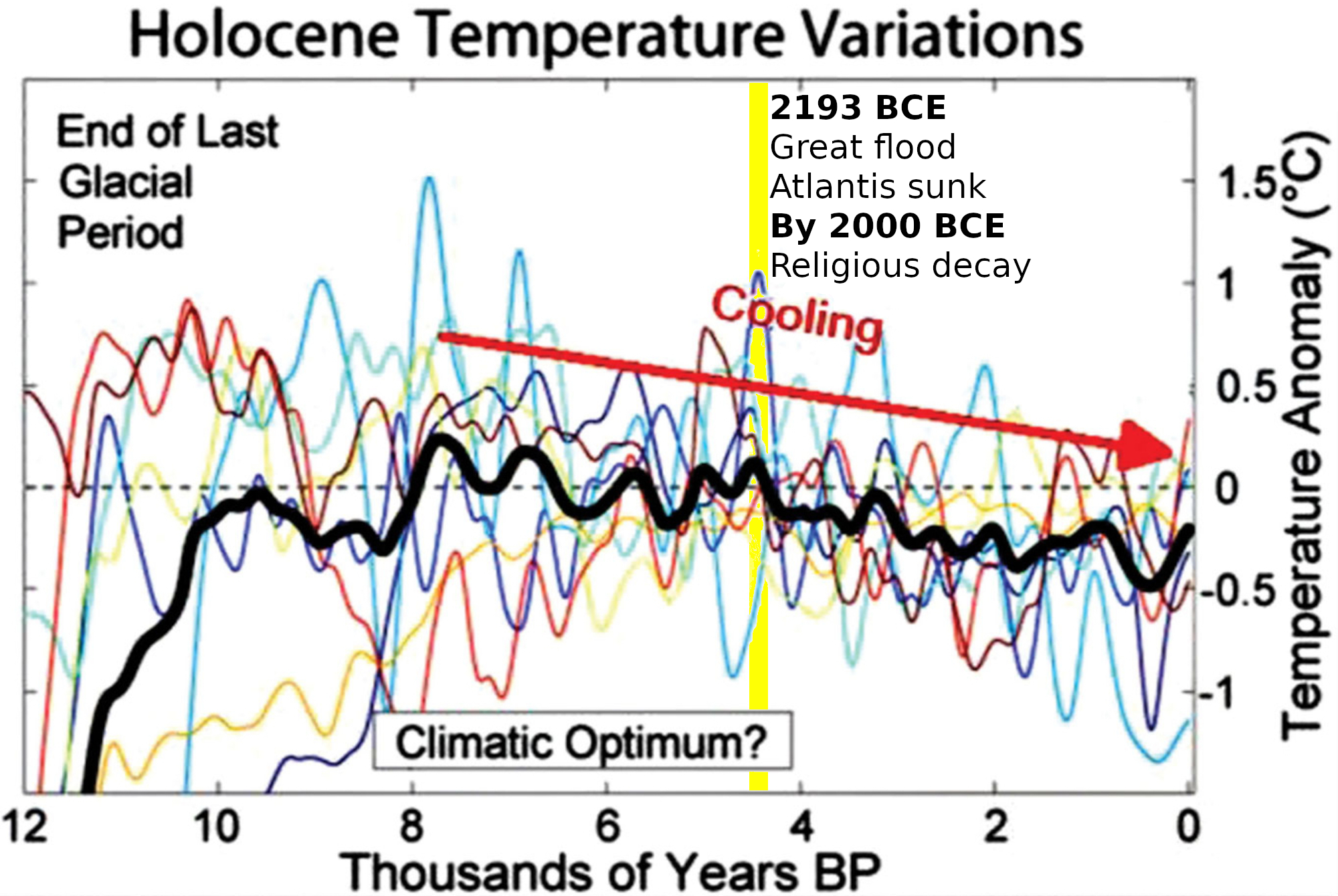
Holocene, great flood, and religious decay
Warm temperatures of the Holocene period spawned agricultural and industrial advances over the past 10,000 years, making modern civilization possible. Since peaking about 8,000 years ago, temperatures in the Holocene have trended downward. According to the OLB,1 in 2193 BCE a great flood occurred and Atlantis sank. This catastrophe was part of what scientists today know as the 4.2-kiloyear (thousand years) BP aridification event,7 one of the most severe climatic events of the Holocene epoch. It involved flooding in some areas and drought in others.
That catastrophic event marked the onset of religious decay as global cooling continued. Donald A. Mackenzie (1915, in Myths of Babylonia and Assyria)8 found that (a) religion in Mesopotamia peaked and started to decline by no later than 2000 BCE and (b) this decline was associated with the arrival in Mesopotamia of Akkadians, a people of Semitic speech with pronounced Semitic affinities, and who from the earliest times were depicted by sculptors as having abundant locks, long full beards, and the prominent distinctive noses and full lips, which we usually associate with the characteristic Jew type.
2.2 Religion
Religious symbols and myths that manifest from a people’s collective unconscious are experiences of deep spiritual realities, consciousness-raising, favourable to life by Nature’s laws, and a coping resource to increase individual and group resilience.9, 10
If the flow of spiritual Force via organic religious roots is corrupted, we can die as a nation, race and species. A viable religion cannot be contrived or forced onto people. The violent imposition of an alien Semitic religion (Christianity) onto Europeans, who in turn corrupted the successful religions of non-Europeans, has had disastrous consequences.
There is no question about the critical importance of organic religion in long-term group survival. The decisive role of viable religion in determining the fate of a community, nation and race is well known to sociologists, e.g. Wallis and Bruce (1992).11
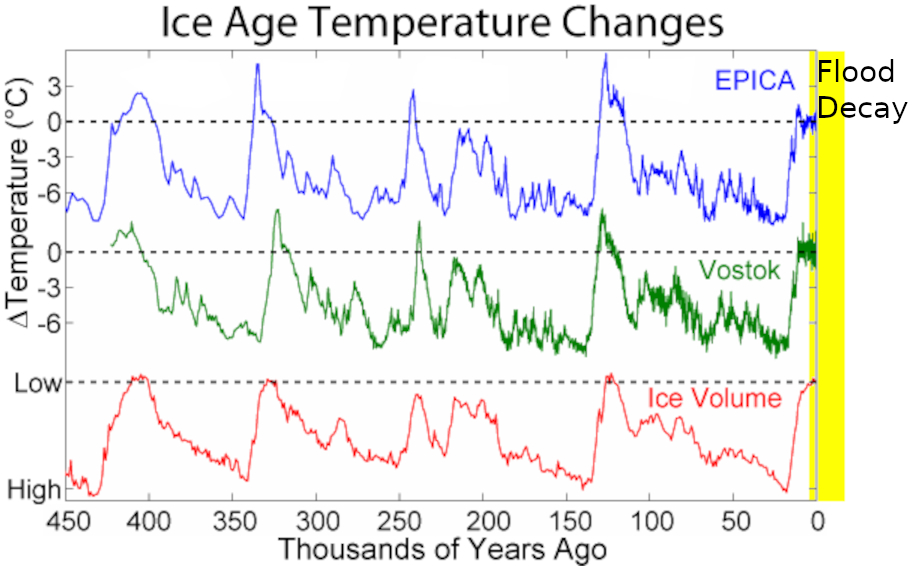
Ice age, great flood, and religious decay
This chart shows the catastrophe of 2193 BCE and the downturn in both global temperature and religion in the wider context of the present ice age.
Within relatively small contexts and time-frames, we can see evidence of cause and effect as it applies to humans. However humans are subject to cosmic processes that are beyond their control and comprehension. Within larger contexts and time-frames (e.g. glacial / inter-glacial periods, geological ages, solar system) the significance of human behaviour vanishes. Everything in our universe is subject to cycles and has a lifespan, including stars, species and civilizations. We can reasonably assume that if our civilization had not decayed via Judaism and its negative expressions (Christianity, Islam, materialism, liberalism, multi-racialism, atheism), it would have succumbed to other similarly-destructive mediating factors. When a system (e.g. tree, human, civilization) nears the end of its life, the universe (God) will have ways to weaken / remove it from the manifest realm of evolution.

2.3 Yin and yang
Yin and Yang is the foundational principle of Chinese philosophy and Chinese medicine. The concept offers a way of understanding the rise / fall of our civilization in conjunction with the rise / fall of global temperatures.
Yin and Yang
- In Chinese the term Yin means the shady side of the hill, and Yang means the sunny side of the hill.
- Is a symbol of balanced opposites.
- Are contradictory and inseparable, e.g. day and night.
- Are equal — neither is superior.
- Everything contains a bit of its opposite – shown by two small dots within the Yin and Yang symbol.
- Can be used to describe any and everything in the universe.
- Increase in one leads to decrease in the other.
Examples of Yin — Yang: feminine — masculine, moon — sun, passive — active, cold — hot, death — life, young — old, dark — light, negative — positive, lies — truth, ignorance — knowledge.
Evil and good cannot be classified as yin or yang. Appropriate terms would include dark — light, negative — positive, lies — truth, ignorance — knowledge.
Agents of Yin (e.g. Jews, Christians, Muslims, materialists, liberals, multi-racialists, atheists) are neither evil nor good.
Similarly, agents of Yang (e.g. Pagans, nature-lovers, the spiritually enlightened, race realists, National Socialists / supporters of Hitlerism, truth-speakers, activists against the Yin-serving group) are neither good nor evil.
Yin and Yang are equally important aspects of evolutionary (creative) processes.
3. Concepts in the OLB
3.1 Sky god and Earth mother
Sky god
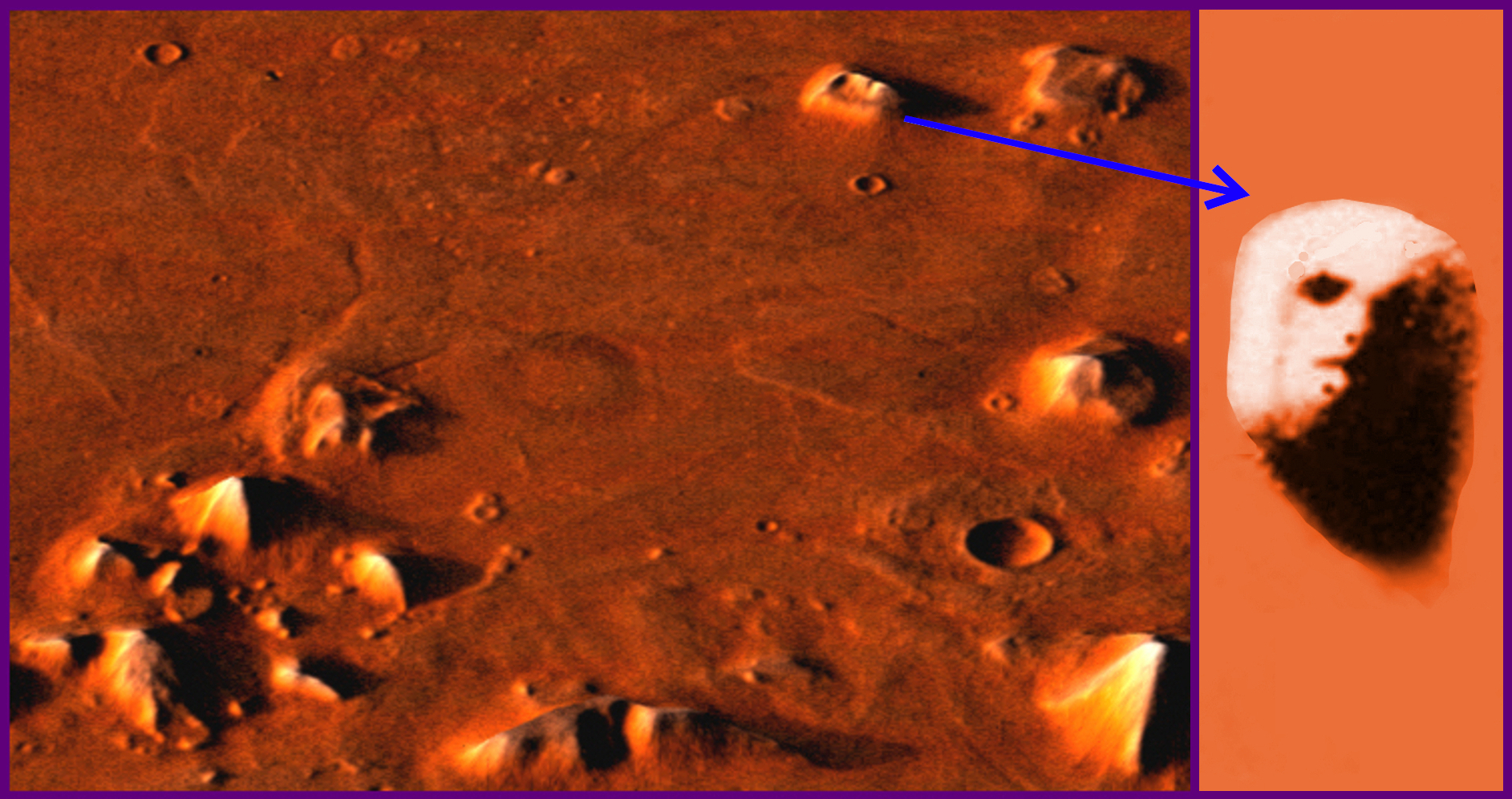
The face sculpture in Cydonia, Mars
These images from NASA,12 taken by Viking 1 Orbiter in 1976, show the face sculpture in the Cydonia region of Mars. The face sculpture is a kilometer wide, and the largest central pyramid is almost ten times larger than the famous pyramid of Cheops in Egypt.13
In natural religion there is a recurring concept of a sky god or sky father, which can be traced to An (Sumerian) and Anu (Akkadian) of the Anunnaki.14 Evidence indicates that the huge face sculpture in the Cydonia region of Mars represents Anu (please see the explanation in Appendix 1).
Other names for the sky god include Horus (Egyptian), Zeus (Hellenic) and Týr (Germanic). In the Oera Linda, the sky god is known as Wr-alda.
From the OLB:
“Wr-alda is the ancient of ancients, for he created all things. Wr-alda is all in all, for he is eternal and everlasting. Wr-alda is omnipresent but invisible, and therefore is called a spirit. All that we can see of him are the created beings who come to life through him and go again, because from Wr-alda all things proceed and return to him. Wr-alda is the beginning and the end. Wr-alda is the only almighty being, because from him all other strength comes, and returns to him. Therefore he alone is the creator, and nothing exists without him. Wr-alda established eternal principles, upon which the laws of creation were founded, and no good laws could stand on any other foundation.” (p 47)
“To Wr-alda’s spirit only shall you bend the knee in gratitude—thricefold—for what you have received, for what you do receive, and for the hope of aid in time of need.” (p 9)
Earth mother
As with the sky god, there are many different names for the Earth mother, dating back to Ki and Ninḫursaĝ (Sumerian). Other names for the Earth mother include Gaia (Greek), Terra Mater (Rome), and Pachamama (Inca). In the OLB, the Earth mother is known as Irtha.
From the OLB:
“It is true that Irtha [the Earth] is named sometimes the feeder of all, because she brings forth all the fruits and grains on which men and beasts are fed; but she would not bear any fruit or grain unless Wr-alda gave her the power.” (p 74)
3.2 Ethnocentrism
Ethnocentrism is the tendency to view one’s group as centrally important and as superior to other groups at the expense of an out-group. It is a universal human reaction found in all known societies, in all groups and in practically all individuals. Everyone learns ethnocentrism while growing up. History for example, is often taught to glorify the achievements of one’s own nation, while religious, civic and other groups disparage their competitors openly. People such as White nationalists who exhibit a healthy and positive evaluation of their own ethnic group are normal human beings. Ethnocentrism is a key mechanism facilitating in-group cooperation. Groups high in ethnocentrism have a “we” feeling; loyalty to comrades; shared ethics and morality; less conflict; high contentment; a positive self-image; pride; love for self and community; and devotion to community, society and country. In-groups do not needlessly hate out-groups or seek to attack them. In-group members concentrate on the performance of altruism within the group rather than aggression toward outsiders unless the competing out-group comes to be seen as a threat.15, 16
The OLB shows that Frisians had healthy levels of ethnocentrism.
Racial and ethnic differences
The OLB describes three archetypal racial figures named Lyda, Finda, and Frya:
“Lyda was black, with hair curled like a lamb’s,” “violent,” “her voice was loud, and when she screamed in anger every creature quailed,” “she had no regard for laws; her actions were governed by her passions,” and “to help the weak she would kill the strong.” (p 7)
“Finda was yellow, and her hair was like the mane of a horse,” “seductive” and “her voice was sweeter than any bird’s,” “her eyes were alluring and enticing, but whoever looked upon them became her slave,” “unreasonable,” “she wrote thousands of laws, but she never obeyed one,” “she despised the frankness of the good, and gave herself up to flatterers,” “she loved nobody but herself, and she wished that all should love her,” “false,” “selfish,” “treacherous,” “one wrong word would irritate her, and the cruelest deeds did not affect her,” and “she wished to rule everybody.” The “fruits of [Finda’s] vanity: the earth overflowed with blood.” (pp 7-8)
“Frya was white like the snow at sunrise, and the blue of her eyes vied with the rainbow,” “beautiful,” “like the rays of the sun shone the locks of her hair, which were as fine as spiders’ webs,” “clever,” “powerful,” “pure,” “sensible,” “wise,” “generous,” and “happy.” “The first lesson that she taught her children was self-control, and the second was the love of virtue; and when they were grown she taught them the value of liberty; for she said, ‘Without liberty all other virtues serve to make you slaves, and to disgrace your origin.’ . . . She never allowed metal to be dug from the earth for her own benefit, but when she did it it was for the general use.” (p 8)
Other (healthy) negative comparisons with groups seen as inferior to Frisians:
- “Lyda’s people can neither make laws nor obey them, they are too stupid and uncivilized. Many are like Finda. They are clever enough, but they are too rapacious, haughty, false, immoral, and bloodthirsty.” (p 19)
- “The toad blows himself out, but he can only crawl. The frog cries “Work, work;” but he can do nothing but hop and make himself ridiculous. The raven cries “Spare, spare;” but he steals and wastes everything that he gets into his beak. Finda’s people are just like these. They say a great deal about making good laws, and every one wishes to make regulations against misconduct, but does not wish to submit to them himself. Whoever is the most crafty crows over the others, and tries to make them submit to him, till another comes who drives him off his perch.” (p 19)
- “. . . the spiteful Finda’s people with their false priests come and attack your ports, ravish your daughters, corrupt your morals, and at last throw the bonds of slavery over every freeman’s neck.” (p 20 )
- “. . . we must not have anything to do with Finda’s people, wherever it may be, because they are full of false tricks, fully as much to be feared as their sweet wine with deadly poison.” (p 22)
- “The people of Finda have also their rules and regulations, but these are not made according to what is just — only for the advantage of priests and princes — therefore their states are full of disputes and murder.” (p 23)
- “Finda’s people are a wicked people, for although they presumptuously pretend among themselves that they are gods, they proclaim the unconsecrated false gods, and declare everywhere that these idols created the world and all that therein is — greedy idols, full of envy and anger, who desire to be served and honoured by the people, and who exact bloody sacrifices and rich offerings; but these presumptuous and false men, who call themselves God’s servants and priests, receive and collect everything in the name of the idols that have no real existence, for their own benefit.” (p 48)
- “The people who live on the south side of the Mediterranean Sea, come for the most part from Phœnicia. The Phœnicians (Puniers or Carthaginians) are a bastard race of the blood of Frya, Finda, and Lyda. The Lyda people were there as slaves, but by the unchastity of the women these black people have degenerated the other people and dyed them brown.” (p 77)
- “You must teach the children how great our country has been, what great men our forefathers were, how great we still are, if we compare ourselves to others. . . . You must tell them of the sea-heroes, of their mighty deeds and distant voyages. All these stories must be told by the fireside and in the field, wherever it may be, in times of joy or sorrow; and if you wish to impress it on the brains and the hearts of your sons, you must let it flow through the lips of your wives and your daughters.” (p 5)
3.3 Respectful treatment of other groups
- No slaves. “Frya has said we must not admit amongst us any but free people; but what have they done? They have imitated our enemies, and instead of killing their prisoners, or letting them go free, they have despised the counsel of Frya, and have made slaves of them.” (p 4)
- No interference or harm. “Meddle not with the people of Lyda, nor of Finda, because Wr-alda would help them, and any injury that you inflicted on them would recoil upon your own heads.” (p 10)
- Help if requested but retaliate violently. “If it should happen that they come to you for advice or assistance, then it behoves you to help them; but if they should rob you, then fall upon them with fire and sword.” (p 10)
- No intervention unless the request is insistent. “If any of our neighbours quarrel and fight about any matter except land, and they request us to arbitrate, our best course will be to decline; but if they insist upon it, it must be done honourably and justly.” (p 18)
- No involvement in others’ conflicts and problems. “If any one comes and says, I am at war, you must help me; or another comes and says, My son is an infant and incompetent, and I am old, so I wish you to be his guardian, and to take charge of my property until he is of age, it is proper to refuse in order that we may not come into disputes about matters foreign to our free customs.” (p 18)
- Kindness toward non-Whites at arm’s length. “Ten years after that the seafarers came from Forana and Lydasburgt. They wished to drive the black men, with their wives and children, out of the country. They wished to obtain the opinion of the mother upon the subject. She asked them: Can you send them all back to their country? If so, then lose no time, or they will find no relatives alive. No, they said. Gosa replied: They have eaten your bread and salt; they have placed themselves entirely under your protection. You must consult your own hearts. But I will give you one piece of advice. Keep them till you are able to send them back, but keep them outside your citadels. Watch over their morals, and educate them as if they were Frya’s sons.” (p 54)
Note: The tone of OLB advice on dealing with other groups echoes that which ET Aliens (presumably Tall Whites / Nordics / Pleiadians / Anunnaki) gave Wilbert B. Smith (1910-1962, B.Sc. and M.Sc. in Electrical Engineering, occupied a responsible position in the Canadian government, authored several technical papers, and undertook formal research into the subject of ETs). The ETs told Wilbert Smith that (a) ETs are interested in us and (b) they stand by ready, able and willing to help us, but (c) ETs cannot help us until we are ready for their help, because (d) to intervene before we are ready would be in violation of a universal law against interference in the affairs of others and (e) violation of this universal law leads to suffering.17
3.4 Freedom
- “Every man knows that he wishes to live free and undisturbed, and that others wish the same thing.” (p 23)
- “All free-born men are equal, wherefore they must all have equal rights on sea and land, and on all that Wr-alda has given.” (p 13)
- “Prosperity awaits the free. At last they shall see me again. Though him only can I recognise as free who is neither a slave to another nor to himself.” (p 9)
- [Wichhirte to Alexander] “Oh greatest of kings, we sailors go everywhere; we have heard of your great deeds, therefore we are full of respect for your arms, and still more for your wisdom; but we who are free-born Fryas children, we may not become your slaves; and even if I would, the others would sooner die, for so it is commanded in our laws.” (p 55)
- “If by force or necessity any regulations should be imposed upon us at variance with our laws and customs, we must submit; but should we be released, we must always return to our own again.” (p 10)
- “Our descendants shall teach their people and their slaves the meaning of three words; they are universal love, freedom, and justice. At first they shall shine, then struggle with darkness, until every man’s head and heart has become bright and clear. Then shall oppression be driven from the earth, like the thunder-clouds by the storm-wind, and all deceit will cease to have any more power.” (p 63)
Threats to freedom
- Defencelessness. “At last they were at a loss themselves for weapons and necessaries, and this difficulty was their punishment. Their bodies were brilliantly adorned, but their cupboards and their sheds were empty. . . . The child asked its mother for food; she had no food to give, only jewels. The women applied to their husbands, the husbands appealed to the counts; the counts had nothing to give, or if they had, they hid it away. . . .” “. . . the Finns came to the defenceless villages and ran away with the children. As they had no good weapons, they lost the battle, and with it their freedom, and Magy became master.” (pp 39-40)
- Timidity. “The Hindoos are timid and submissive before their princes, like hinds before wolves. Therefore the Yren and others have called them Hindoos, which means hinds. But their timidity is frightfully abused.” (p 72)
- Traitorous religious figures. “Beloved successors, for the sake of our dear forefathers, and of our dear liberty, I entreat you a thousand times never let the eye of a monk look on these writings. . . . they destroy in an underhand manner all that relates to us Frisians. In order to gain rich benefices, they conspire with foreign kings, who know that we are their greatest enemies, because we dare to speak to their people of liberty, rights, and the duties of princes.” (p 3)
3.5 Contempt for arrogance
- “The foreign kings, who follow their own will, place Wr-alda below the crown. . . . they had statues of themselves made, and erected in the churches beside the statues of the idols, and those who would not bow down to them were either killed or put in chains.” (pp 74-75)
- “But it is not only that some of your men have been guilty of stealing titles, I have also much to complain of against your wives. If there are men among you who wish to put themselves on a level with Wr-alda, there are also women who wish to consider themselves equals of Frya.” (p 75)
- “You all fancy that you are the better for this name-stealing, but you forget that jealousy clings to it, and that every wrong sows the seed of its own rod. If you do not alter your course, in time it will grow so strong that you cannot see what will be the end. Your descendants will be flogged by it, and will not know whence the stripes come. . . . Your ghosts will rise frightened out of their graves.” (p 75)
- “God’s servants and priests, receive and collect everything in the name of the idols that have no real existence, for their own benefit. They do all this with an easy conscience, as they think themselves gods not answerable to any one. If there are some who discover their tricks and expose them, they hand them over to the executioners to be burnt for their calumnies, with solemn ceremonies in honour of the false gods; but really in order to save themselves.” (p 48)
- “Among Finda’s people there are false teachers, who, by their over-inventiveness, have become so wicked that they make themselves and their adherents believe that they are the best part of Wr-alda, that their spirit is the best part of Wr-alda’s spirit, and that Wr-alda can only think by the help of their brains.” (pp 47-48)
- “The Romans, moreover, live at enmity with the Phœnicians; and their priests, who wish to assume the sole government of the world . . . and they have always driven away the Phœnician priests . . . .” (p 77)
3.6 Language
- “When Wr-alda gave children to the mothers of mankind, he gave one language to every tongue and to all lips.” (p 69)
- “As thus our language . . . is rightly named the language of the gods, and all those by whom it is held in honour derive honour from it”. (p 69)
- “. . . you must never allow any language but God’s language to pass your lips, and take care that your own language remains free from outlandish sounds.” (p 70)
- “If foreigners come to buy ironwares from you, and want to talk and bargain, they must come back to God’s language. If they learn God’s language, then the words, “to be free” and “to have justice,” will come to them, and glimmer and glitter in their brains to a perfect light, and that flame will destroy all bad princes and hypocritical dirty priests.” (p 71)
- “The deceitful priests and the malignant princes, who always clung together, wished to live according to their own inclinations, without regard to the laws of right. In their wickedness they went so far as to invent other languages, so that they might speak secretly in anybody’s presence of their wicked and unworthy affairs without betraying themselves . . . .” (p 70)
3.7 Other
- Dishonest foreigners. “Whenever a foreign trader comes to the open markets at Wyringen and Almanland, if he cheats, he must immediately be fined, and it must be published by the maidens throughout the whole country. If he should come back, no one must deal with him. He must return as he came.” (p 18)
- Ill-treatment in a foreign market. “If we should be ill-treated in a foreign market, whether distant or near, we must immediately attack them; for though we desire to be at peace, we must not let our neighbours underrate us or think that we are afraid.” (pp 18-19)
- Usurers. “There shall be no usurers in the market. If any should come, it will be the duty of the maidens to make it known through the whole land, in order that such people may not be chosen for any office, because they are hard-hearted. For the sake of money they would betray everybody—the people, the mother, their nearest relations, and even their own selves.” (p 14)
- Sale of freedom. “If ever it should happen that one of your people should sell his freedom, he is not of you, he is a bastard. I counsel you to expel him and his mother from the land. Repeat this to your children morning, noon, and night, till they think of it in their dreams.” (p 10)
- Depriving another of liberty. “If any man shall deprive another, even his debtor, of his liberty, let him be to you as a vile slave; and I advise you to burn his body and that of his mother in an open place, and bury them fifty feet below the ground, so that no grass shall grow upon them. It would poison your cattle.” (p 10)
- Traitors. “If any man should prove a traitor and show to our enemies the paths leading to our places of refuge, or creep into them by night, he must be the offspring of Finda; he must be burnt.” (p 24)
- The common good. “Whenever new laws are made or new regulations established, they must be for the common good, and not for individual advantage.” (p 16)
- Wisdom and rectitude. “Eternal and unalterable are the signs wisdom and rectitude, which must be sought after by all pious people, and must be possessed by all judges. If, therefore, it is desired to make laws and regulations which shall be permanent, they must be equal for all men.” (p 19)
- Education. “The writer must teach the girls to read, to write, and to reckon. The elders, or “Greva,” must teach them justice and duty, morals, botany, and medicine, history, traditions, and singing, besides all that may be necessary for them to give advice.” (p 51)
4. The destruction of Atlantis
The OLB records the destruction of Atland (âldland, old land, in Latin Atlantis) in 2193 BCE. That date is given by the year 1256 of our era, when Hiddo overa Linda made the copy, stating that it was was 3449 years after Atland sank (3449 – 1256 = 2193 BCE).
“From this writing it appears that [Atlantis] was land stretching far out to the west of Jutland, of which Heligoland and the islands of North Friesland are the last barren remnants. This event . . . occasioned a great dispersion of the Frisian race . . . . [and] is known by geologists as the Cimbrian flood” (Dr J. G. Ottema, 1871, in the introduction to the OLB English translation by William R. Sandbach, 1876, p 85).1
From the OLB:
“Before the bad time came our country was the most beautiful in the world. The sun rose higher, and there was seldom frost. The trees and shrubs produced various fruits, which are now lost. In the fields we had not only barley, oats, and rye, but wheat which shone like gold, and which could be baked in the sun’s rays. The years were not counted, for one was as happy as another.” (p 26)
How the bad time came
“During the whole summer the sun had been hid behind the clouds, as if unwilling to look upon the earth. There was perpetual calm, and the damp mist hung like a wet sail over the houses and the marshes. The air was heavy and oppressive, and in men’s hearts was neither joy nor cheerfulness. In the midst of this stillness the earth began to tremble as if she was dying. The mountains opened to vomit forth fire and flames. Some sank into the bosom of the earth, and in other places mountains rose out of the plain. Aldland, called by the seafaring people, Atland, disappeared, and the wild waves rose so high over hill and dale that everything was buried in the sea. Many people were swallowed up by the earth, and others who had escaped the fire perished in the water.
It was not only in Finda’s land that the earth vomited fire, but also in Twiskland (Germany). Whole forests were burned one after the other, and when the wind blew from that quarter our land was covered with ashes. Rivers changed their course, and at their mouths new islands were formed of sand and drift.
During three years this continued, but at length it ceased, and forests became visible. Many countries were submerged, and in other places land rose above the sea, and the wood was destroyed through the half of Twiskland (Germany). Troops of Finda’s people came and settled in the empty places. Our dispersed people were exterminated or made slaves. Then watchfulness was doubly impressed upon us, and time taught us that union is force.” (p 27)
“At the time of the submersion of Atland, the first spoke of the Juul [winter solstice, Yule] stood at the top. After that it went down, and our freedom with it. When two spokes, or two thousand years, shall have rolled down, the sons shall arise who have been bred of the fornication of the princes and priests with the people, and shall witness against their fathers. They shall all fall by murder, but what they have proclaimed shall endure, and shall bear fruit in the bosoms of able men, like good seed which is laid in thy lap. Yet a thousand years shall the spoke descend, and sink deeper in darkness, and in the blood shed over you by the wickedness of the princes and priests. After that, the dawn shall begin to glow. When they perceive this, the false princes and priests will strive and wrestle against freedom; but freedom, love, and unity will take the people under their protection, and rise out of the vile pool. The light which at first only glimmered shall gradually become a flame.” (pp 40-41)
“When our land was submerged I was in Schoonland. It was very bad there. There were great lakes which rose from the earth like bubbles, then burst asunder, and from the rents flowed a stuff like red-hot iron. The tops of high mountains fell and destroyed whole forests and villages. I myself saw one mountain torn from another and fall straight down. When I afterwards went to see the place there was a lake there.” (p 59)
“One hundred and one years after the submersion of Aldland a people came out of the East. . . . like the Egyptians, they have priests and also statues in their churches. The priests are the only rulers; they call themselves Magyars, and their headman Magy. He is high priest and king in one. . . . they are slaves to their priests, and still more to their creeds. . . . of Wr-alda’s spirit they know nothing. . . . When they were well established, the Magyars sought our friendship . . . they always kept their people within their own boundaries, and that outwitted our watchfulness. . . . Eighty years afterwards, just at the time of the Juulfeest, they overran our country like a snowstorm driven by the wind. All who could not flee away were killed.” (pp 27-28)
5. Jessos
The OLB (pp 61-62 ) records that at the time Atlantis was submerged, upon a mountain, on a plain called Kasamyr (Cashmere), Jessos was born. His mother was the daughter of a king, and his father was a high-priest. “In order to hide the shame they were obliged to renounce their own blood. Therefore it [Jessos] was taken out of the town to poor people. As the boy grew up, nothing was concealed from him, so he did all in his power to acquire wisdom. His intellect was so great that he understood everything that he saw or heard. The people regarded him with respect, and the priests were afraid of his questions.” (p 61) Jessos wandered about. Wherever he went he taught the people:
- To not tolerate rich men or priests.
- To guard themselves against false shame, which harms love and charity.
- The earth bestows her treasures on those who dig and plough.
- To sow if they wish to reap.
- No one is obliged to do anything for another unless it be out of goodwill.
- Do not seek gold, silver, or precious stones, which causes envy and destroys love.
- No man is able to make everybody equally rich and happy.
- But it is the duty of all men to make each other as equally rich and as happy as possible.
- Men should not despise any knowledge.
- Justice is the greatest knowledge, because it wards off offences and promotes love.
The priests hated Jessos but the people called him Krishna (shepherd) and his Frisian friend called him Buddha (purse), because he had in his head a treasure of wisdom, and in his heart a treasure of love.
Eventually Jessos had to flee from the wrath of the priests but his enemies followed him like his shadow. Wherever Jessos went, his teaching had preceded him. After traveling like this for twelve years, he died. His friends preserved his teaching and shared it wherever they found listeners.
6. References
- The Oera Linda Book, English translation by William R. Sandbach, 1876.
- Wikipedia: Oera Linda Book
- Der Tag, Berlin, 31 December 1933.
- Dugin, Aleksandr (1996). The Racial Archetypes of Eurasia in the Oera Linda Chronicle (1996). Transl. Jafe Arnold) (Absoliutnaia Rodina), Moscow, Arktogeya: 1999, chapter 8.
- Cooper, Paul. Fall of Civilizations
- Wikipedia: List of empires
- Wikipedia: 4.2-kiloyear event
- Mackenzie, Donald A. (1915). Myths of Babylonia and Assyria.
- Lazarus, Richard, & Folkman, Susan (1984). Stress, appraisal, and coping, New York: Springer.
- Lazarus, Richard (1999). Stress and emotion: A new synthesis, New York: Springer.
- Wallis, R. & Bruce, S. (1992). Religion and Modernization. Pub. Oxford University Press.
- NASA
- Petrovych, V. A. & Fedorovich, S. A. (2023). Microrelief of the Martian surface.
- Wilkin, Stanley (2019). Jesus and Bel Christianity and the Continuation of Paganism.
- MacDonald, Prof. Kevin (2012) Ethnocentrism is normal and rational.
- Sociology Guide (2019).
- Smith, Wilbert B. (1958). Video: The Ottawa Address, 31 Mar 1958.
7. Appendices
1. Tall Whites on Mars
The Greada Treaty
According to former naval intelligence officer William Cooper in Chapter 12 of his book Behold a Pale Horse (1991), in 1953 astronomers discovered large objects heading toward Earth. Later evidence revealed that the objects could only be spaceships. The spaceships contained Grey ETs and took up a very high orbit around the equator. Through radio communications using the computer binary language, face-to-face contact with the ETs was arranged. Consequently during 1954 these Greys landed at Holloman Air Force Base for a meeting with President Eisenhower and others. At this meeting an agreement known as The Greada Treaty was signed. According to William Cooper, the treaty included the following: (a) We would keep their presence on Earth a secret, (b) They would give us advanced technology and help us to develop technologically, and (c) They could abduct humans on a limited and periodic basis for scientific and medical purposes.
Tall Whites’ reaction to the above
According to William Cooper in Chapter 12 of his book Behold a Pale Horse (1991), when Grey ETs visited Earth in 1953 and 1954, Tall Whites (aka Nordics, Pleiadians, Anunnaki, although these are not necessarily all the same beings — please see Appendix 2) quickly reacted by contacting the US Government, warning against the Grey ETs then orbiting the equator. The Tall Whites offered to help us with our spiritual development. They refused to share their advanced technology with us, saying that we were not spiritually ready for it and would use such technology for destructive purposes.
Literature reviewed by engineer and educator Andrew Johnson (2019) in Acknowledged: A perspective on UFOs, Aliens and Crop Circles indicates that on 20 February 1954 at Edwards (Muroc) Air Force Base, President Eisenhower and others met with two white-haired Tall Whites / Nordics. They had pale blue eyes and colourless lips. These ETs arrived in a bi-convex saucer that stood on tripod landing gear on the landing strip. The Eisenhower administration rejected the Nordics’ offer of spiritual rather than technological help and instead formed the above-mentioned agreement with the Greys.
The Tall Whites’ immediate origin
Their observation of the Greys’ arrival, quick reaction, and speedy visit to Earth suggests that the Tall Whites were relatively close to Earth at that time.
Specifically, evidence suggests that they could have been on Mars:
In May 1984 the US Government discovered an ET race on Mars via the remote viewing (non-local perception, sensing with the mind) of the esteemed remote viewer Joseph McMoneagle. In addition to other features of Mars such as huge dust storms, massive pyramids, megaliths, intersecting roads, and aqueducts, Joseph McMoneagle saw a group of tall and slender humanoids. His description of these ETs seems to suggest that they were Tall Whites.
As will be shown in future posts, the evidence linking Tall Whites (typically referred to as Anunnaki in this context) to both Mars and Earth is now compelling, and includes (a) matching human/oid-made structures on Mars and Earth, (b) matching symbolism of those structures, (c) physical remains found on Earth of fair-skinned, blonde- and red-haired humanoids with substantially larger-than-human cranium capacities (superior intelligence), (d) related evidence indicating the historic presence of highly-advanced Aryan-type ETs on Earth, and (e) a genetic link between those ETs and humans. As the Anunnaki sky god is An (Sumerian) and Anu (Akkadian), (Stanley Wilkin, 2019, University of London, Jesus and Bel Christianity and the Continuation of Paganism) and the huge Face sculpture faces the sky, logically, the Face sculpture is most likely an Anunnaki representation of Anu.
2. German crews of ET-type craft
There is reason to believe that the beings who are variously referred to as Tall Whites, Nordics, Pleiadians, and Anunnaki are not all the same beings. For example, Ernst Zündel’s (1974) carefully researched book UFOs: Nazi secret weapon? suggests that Germans are pursuing the Aryan cause secretly with advanced technology from bases on Earth and perhaps elsewhere. This seems to explain (a) the reported encounters with German-speaking / looking anti-gravity craft crews who do not fit the usual picture of ET Alien encounters and (b) the onset of those ET-type encounters — they only occurred post-WW2. For example, it is written that in 1959, three large newspapers in Chile reported front-page articles about encounters with UFOs that seemed to be crewed by German soldiers, and in the early 1960s there were reports in New York and New Jersey of ET-type flying saucers crewed by ‘aliens’ who spoke German or English with a German accent.
 Aspects of Mind
Very well written article friend. It is interesting to note that on page 63 of the OLB, while describing Jesus or Jessos of kasmir, the claim is made that the priests (who initially despised him) claimed to love him and even turned him into a god “What do you think the priests did then? That I must tell you, and you must give your best attention to it. Moreover, you must keep guard against their acts and their tricks with all the strength that Wr-alda has given you. While the doctrine of Jessos was thus spreading over the earth, the false priests went to the land of his birth to make his death known. They said they were his friends, and they pretended to show great sorrow by tearing their clothes and shaving their heads. They went to live in caves in the mountains, but in them they had hid all their treasures, and they made in them images of Jessos. They gave these statues to simple people, and at last they said that Jessos was a god, that he had declared this himself to them, and
that all those who followed his doctrine should enter his kingdom hereafter, where all was joy and happiness.” I have my doubts that this was the same Jesus as described in the NT, as Jesus was a fairly common name, in Greek Ἰησοῦς (Iēsous) simply means ‘he saves’. However perhaps the NT Jesus was copied from this story, and made into a god. Since Abrahamism seems to plagarize all of the other faiths. I think that Wr-alda is the eternal creator, not a mere god like Odin or thor, as the book describes him as everlasting.
It’s interesting that you mentioned Himmler and the Ahnenerbe, if I recall I think he termed it as the “Aryan Scriptures” there was an entire debate over the OLB within the NSDAP. The article below has some good info, skip to the Battle of the university of Berlin Part. (https://joshualightningwarrior.wordpress.com/the-oera-linda-book/the-fryan-question/)
Thanks again for the sources on the tall White/Nordic Aliens, I am a novice with this type of research and find it interesting that the US government blatantly ignored their advice (I suppose they are jew influenced) and went for a deal with greys.
Thanks again, Wralda bless.
LikeLike
Friend Christopher, thanks for your positive and interesting comments!
Concerning “Jessos,” yes, the psychopathic tribe tries to exploit issues to their advantage. As is said of them, they try to play both / all sides of an issue to their advantage.
Concerning the possibility of the tribe basing their jew “Jesus” lie on Jessos, the saviour god is an old pagan idea. In my post The Christian deception, there are listed many Jesus-like saviour gods that could have inspired the jew Jesus lie. In another post (The Christ-Con and its Cure), the facts presented show that jew Jesus is a jew lie by Philo Judaeus (Philo the Jew) and his nephews Tiberius Julius Alexander aka “Josephus” and Thaddeus Alexander Herod aka “Paul the Apostle.”
Then there is the story of Esus, a powerful Celtic deity, one of three mentioned by the Roman poet Lucan in the 1st century AD. A relief of Esus in the Cathedral of Notre-Dame in Paris shows him as a bent woodman cutting a branch from a willow tree. Like Jesus, Esus was a carpenter (wood cutter) and both J/esus were involved in human sacrifice on wood, and both were involved in stabbing (Esus stabbed others, Jesus was supposedly stabbed while on the cross).
Yes, evidence shows that in keeping with their reputation as people of the lie, Abrahamism is yet another example of jew theft from others.
Although Odin is also sometimes referred to as a sky father, all-father, and eternal creator, I like the extreme simplicity and purity of the monotheistic Frisian religion, including the clearly-defined and unambiguous nature of Wr-alda.
I can see why Himmler and others favoured the Frisian religion and referred to the OLB as the Aryan Scriptures or similar. I can also see the appeal and value of an Odinist-type Aryan religion. I don’t mind what we call the Sky god and the Earth mother, and the nature-orientated aspects of Odinism strongly appeal to me. Also, to my mind, Odinism and the OLB are compatible and lend themselves to integration.
However, practically and strategically, for Aryans who want (a) a quick re-connection to our ancestral religion (no need to learn about many gods and religious rituals), (b) the simplicity, elegance, and intuitive appeal of monotheism, and (c) the wisdom and guidance of a comprehensive and life-promoting ‘Bible’ (incomparably superior to the destructive jew nonsense of the Christ-insane Bible), the OLB is the very best that we have.
Yes, it seems that the psychopathic jews and the psychopathic greys have a natural affinity, while the Tall Whites / Nordics seem to have a natural affinity with Aryans. I referred to that in the Aspects of Aliens posts. However, I need to organize information more clearly in a new blog.
Thanks for your article link, including the section on The Battle of the University of Berlin! I’ve previously read around the OLB authenticity subject and would bet my life on the OLB being totally genuine. As the article states, it seems that the NSDAP rejected the OLB for political rather than scholarly reasons.
Concerning the article’s reference to a wide geographic distribution of early Aryans, I learned about this from the informative Asha Logos videos that you kindly sent me links to. From those videos I learned about the genetic, artistic, religious, and other evidence of such. I summarized information from the Asha Logos videos and intend referring to those videos in a future post.
Christopher thanks for all your comments and links provided across various posts! This post is a small part of what I am preparing to put on the blog. In particular, thanks very much for telling me about the OLB! Greatly appreciated!
Wr-alda bless.
LikeLike
Amazing how that resonates, compared to the complicated catechisms pounded into my head as a kid. Thank you.
LikeLike
Celticbiker thank you for your positive comment!
You are most welcome!
I too am a recovered Catholic! I liked many of the priests and nuns but their teachings never resonated with me.
In contrast, the Frisian religion as documented in the OLB is deeply meaningful and appealing.
I am working on more articles concerning our racial identity and religion. Those articles will appear on this blog in due course.
LikeLike